


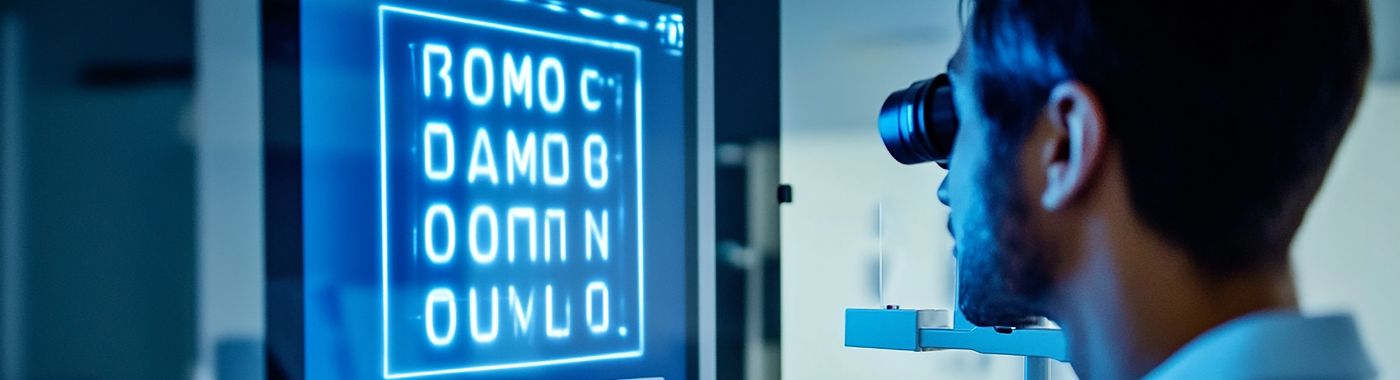
A depth perception test measures how well the two eyes work together to judge distance in three dimensions. Most clinical tests measure stereoacuity using polarised or random-dot targets. The depth perception test does not measure sharpness of vision, eye pressure or retinal health, and a normal result does not exclude eye or brain disease.
ቁልፍ ማውጫዎች
- ዓላማው: The depth perception test assesses binocular (two-eyed) depth judgement, usually reported as stereoacuity in seconds of arc.
- ወሰን: The test screens for problems with eye alignment and binocular fusion; the test does not identify the cause on its own.
- ጥረት The test is quick, non-invasive and painless, and is usually part of a wider eye examination rather than a standalone check.
- የአቅም ገደብ: Uncorrected refractive error, poor cooperation, guessing and monocular clues can all shift the result.
- ትርጉም- Stereoacuity figures need interpretation by the optometrist or ophthalmologist who examined you, alongside visual acuity and alignment findings.
በጨረፍታ
| የሚለካው | Ability of both eyes together to detect small differences in depth (stereopsis) |
|---|---|
| Common test types | Titmus/Randot-style polarised tests, random-dot stereograms, Lang test, TNO test, Frisby test |
| ማን ያከናውናል | Optometrist, orthoptist or ophthalmologist |
| የተለመደ ቆይታ | About 2-10 minutes for the stereo test itself; longer with children or when part of a full eye examination (commonly 30-45 minutes) |
| አዘገጃጀት | Bring and wear your current glasses or contact lenses; follow your clinic's instructions |
| አለመመቻቸት | None expected; special polarised or red-green glasses are worn over your own spectacles |
| የውጤት ቅርጸት | Stereoacuity in seconds of arc, or "stereopsis present/absent/gross" |
| Sedation or injections | ግዴታ አይደለም |
ተብሎም ይታወቃል
- Stereopsis test, stereoacuity test, 3D vision test
- Binocular vision test, "both eyes together" test
- Titmus fly test, Randot test, random-dot stereogram test
- Commonly asked for in India as "3D chashma test", "depth test for driving licence", or "eye test for pilot/defence medical"
What the depth perception test is
Depth perception is the ability to judge how far away objects are and how they sit in space relative to one another. Two sets of clues contribute. Monocular clues, object size, overlap, shadows, perspective, motion, work even with one eye. Binocular clues depend on each eye seeing a slightly different view; the brain fuses the two images and extracts depth. That binocular component is called stereopsis.
A clinical depth perception test is designed to isolate stereopsis. The patient wears polarised or red-green filter glasses and views plates or targets that contain a hidden shape offset slightly between the two eye views. Graded plates become progressively harder, and the finest plate correctly identified gives the stereoacuity value in seconds of arc, a smaller number means finer depth discrimination.
Random-dot tests (Randot, TNO, Lang) are usually preferred when the aim is to detect genuine stereopsis, because contour-based plates such as the Titmus fly can sometimes be answered using monocular clues. Results vary depending on individual clinical circumstances, the test used and the testing distance.
Why the depth perception test is done
- To assess binocular function in suspected strabismus (squint, eye misalignment) or convergence problems.
- To support assessment of amblyopia (lazy eye) and to monitor whether binocular function improves with treatment.
- To monitor orthoptic or surgical progress after squint surgery, patching, glasses or vision therapy.
- As part of paediatric vision screening, where reduced stereopsis can be an early clue to an unequal refractive error or a squint that the child has not complained about.
- For occupational and licensing assessments: some aviation, defence, railway, commercial driving and heavy-machinery roles include binocular vision requirements. Requirements are set by the relevant authority, not by the testing clinic, so confirm the exact standard with the recruiting or licensing body.
- To help explain symptoms such as difficulty judging steps, kerbs, pouring, threading a needle, parking, or catching a ball.
ይህንን ፈተና ማን መውሰድ አለበት
- Children with a visible or suspected squint, a family history of squint or amblyopia, or a head turn/tilt.
- Children who are clumsy with stairs, catching, or close work, or who close or cover one eye.
- Anyone with new double vision, eye strain or headache on prolonged near work.
- Adults after squint surgery, eye muscle palsy, orbital trauma, or treatment for amblyopia.
- People with a large difference in prescription between the two eyes, or with reduced vision in one eye for any reason (cataract, corneal scar, retinal disease).
- Applicants for jobs or licences with a stated binocular vision standard.
- People with neurological conditions affecting vision, after stroke, head injury, or in suspected visual processing problems, as one part of a broader assessment.
Routine repeat testing is not needed if you have no symptoms and your last eye examination was normal. Children benefit from age-appropriate vision checks even without complaints, because young children rarely report a problem themselves.
What the depth perception test cannot detect or exclude
Understanding the limits matters as much as the result.
- The test does not measure sharpness of vision. Visual acuity is measured separately with a letter or symbol chart.
- The test does not assess the retina, optic nerve, macula or intraocular pressure. Normal stereoacuity does not exclude glaucoma, diabetic retinopathy, macular disease or optic nerve disease. These need dilated fundus examination, tonometry and, where indicated, imaging.
- The test does not diagnose the cause. Reduced stereoacuity indicates that binocular depth processing is not working well; it does not distinguish between a squint, unequal refractive error, media opacity such as cataract, or a brain-level problem.
- The test does not measure practical depth judgement in the real world. People with absent stereopsis often function well using monocular clues, including driving, and some can be perfectly safe in daily tasks. Conversely, good stereoacuity on a plate does not guarantee safe performance in complex tasks.
- The test does not reliably exclude a small-angle squint. Microtropia can coexist with measurable, though reduced, stereopsis; cover testing and prism measurement are needed.
- Normal is not the same as excluded. A normal result describes what was found on that day, with that test, at that distance. If your symptoms continue despite a normal result, go back to your eye doctor rather than assuming nothing is wrong.
ተዛማጅ ግን የተለያዩ ፈተናዎች
Depth perception testing is one item in a binocular vision workup. These examinations answer different questions and are not interchangeable.
| ፈተና | የሚል ጥያቄ ይመልሳል | ምን አይነግርህም? |
|---|---|---|
| Stereoacuity test (depth perception test) | How finely do the two eyes together detect depth? | Cause of the problem; clarity of vision; eye health |
| Visual acuity test (Snellen, LogMAR, symbol charts) | How clearly does each eye see detail? | Whether the eyes work together |
| Cover test and prism cover test | Is there a squint, in which direction, and how large? | Quality of depth perception |
| Ocular motility and convergence assessment | Do the eyes move fully and converge for near work? | Stereoacuity value |
| Refraction / cycloplegic refraction | What spectacle power does each eye need? | Binocular fusion quality |
| Worth four-dot test / Bagolini striated glasses | Is there fusion or suppression of one eye? | Fineness of depth discrimination in arc seconds |
| Synoptophore / major amblyoscope assessment | Detailed sensory and motor fusion mapping in strabismus | Replacement for clinical plate stereotests |
| Colour vision test (Ishihara) | Is colour discrimination normal? | Anything about depth perception |
| Fundus examination, OCT, tonometry, visual fields | Structural and functional eye health | Binocular depth function |
A "vision-guided motor task" such as catching a ball or pouring water is a functional observation, useful in children and in rehabilitation, but the task is not a calibrated stereoacuity test and should not be reported as one.
እንዴት እንደሚዘጋጁ
Preparation is minimal, but protocols differ between clinics, so your unit's instructions take precedence over any general advice here.
- Bring your current glasses or contact lenses and wear them during the test if that is what you use for everyday vision. Test glasses (polarised or red-green) are placed over spectacles.
- Bring your old prescription and any previous eye or orthoptic reports, including squint surgery notes.
- List your symptoms: double vision, eye strain, difficulty with stairs or parking, headache pattern, head tilt, and when they began.
- Mention medicines and medical conditions, including thyroid disease, diabetes, myasthenia, neurological illness and any recent head injury. Do not start, stop or change any prescribed medicine for the test; speak to the prescriber if you have concerns.
- Ask whether dilating drops are planned. If drops are used, near vision and glare can be affected for several hours, so arrange transport and do not plan to drive yourself.
- Come rested. Fatigue and prolonged screen use before the appointment can worsen near binocular performance.
ልጆች
Choose an appointment when the child is alert and fed, not at nap time. Bring the feeding items or a favourite toy for cooperation. Explain the test as a game of finding hidden pictures. Cycloplegic (dilating) drops are frequently needed in children to measure refractive error accurately; the pupils may stay large and near vision blurred for several hours to a day, and the child may be light-sensitive. Ask the clinic in advance whether drops are planned.
የቆዩ አዋቂዎች
Cataract, dry eye, reduced contrast sensitivity and unequal vision after cataract surgery can all lower measured stereoacuity. Bring both distance and reading glasses. If you use a walking aid or need help with stairs after dilating drops, bring someone with you.
People with other medical conditions
The depth perception test itself has no fasting requirement and does not interfere with diabetes, kidney disease, heart failure or fluid restriction. If dilating drops or other eye drops are planned, tell the clinician about glaucoma, a history of angle closure, prostate medicines, or drug allergies, so the right agent is chosen.
What happens during the depth perception test and how long it takes
- ታሪክ: The examiner asks about symptoms, past squint or patching, surgery, injury, and general health.
- Baseline vision and alignment: Visual acuity in each eye, refraction if required, cover test and eye movements are usually done first, because they influence how the stereo result is interpreted.
- Stereo testing: You wear filter glasses and are shown a booklet or plates at a set distance, usually about 40 cm for near tests. You point to the shape, animal or circle that appears to stand out or sit forward. The plates become progressively finer until you can no longer tell the difference reliably.
- Distance testing where relevant: Some clinics add a distance stereotest for occupational assessment.
- ማብራሪያ: The examiner records the finest level achieved and discusses findings in the context of the rest of the examination.
ጊዜ ያስፈልጋል the stereo test alone typically takes 2-10 minutes. Within a full eye or orthoptic assessment, expect roughly 30-45 minutes; if dilating drops are used, allow 1.5-2 hours in the clinic. Paediatric assessments often take longer because testing is paced to the child.
ሪፖርትዎን መረዳት
Stereoacuity is reported in seconds of arc, the smallest depth difference you could detect. A smaller number indicates finer depth discrimination. Because each test (Titmus, Randot, TNO, Lang, Frisby) has its own plate steps, testing distance and scoring, values are not directly comparable between tests. Your report should name the test used and the distance.
Other ways a result may be worded:
- Stereopsis present, fine: the finest plates were identified consistently.
- Gross or reduced stereopsis: only coarser levels were achieved.
- Stereopsis absent / nil: no plate was identified reliably. In a child this may reflect suppression of one eye, a squint, or simply inability to cooperate on the day; repeat testing is often needed before concluding anything.
- Unreliable / not assessable: attention, comprehension or fixation did not allow a valid measurement.
What matters clinically is the pattern, not the single figure: stereoacuity read alongside visual acuity in each eye, refractive error, alignment and fusion testing. Do not use an arc-second figure to self-diagnose, and do not use it to judge fitness for a job or licence. Interpretation belongs to the optometrist or ophthalmologist who examined you.
ውጤቶቹ አሳሳች ሊሆኑ የሚችሉበት ጊዜ
Results that look falsely better than true binocular function
- Monocular clues on contour-based plates. The Titmus fly and circles can sometimes be answered by noticing lateral displacement or edge shifts with one eye, so stereopsis may appear present when it is not. Random-dot tests reduce this problem.
- Guessing on forced-choice plates. With a small number of options, a few lucky answers can inflate the score, particularly in young children.
- Cueing. Unintentional prompting, head tilting or tilting the booklet can reveal the target.
- Learning effect. Repeat testing with the same booklet in a short period can improve scores without real change in function.
Results that look falsely worse than true binocular function
- Uncorrected or outdated refractive error, or leaving glasses or contact lenses at home.
- Recent dilating drops or any cause of blurred near vision at the time of testing.
- Dry eye, corneal surface irregularity, dense cataract or media opacity reducing image quality in one eye.
- Poor lighting, tilted plates or wrong testing distance, and filter glasses that do not sit correctly over spectacles.
- Fatigue, illness, anxiety, pain, poor attention, developmental or language difficulty, or a very young child who does not understand the task.
- Colour vision deficiency can make red-green filter tests such as TNO harder to perform.
- Nystagmus or unsteady fixation.
If a result does not fit the clinical picture, the appropriate next step is repeat testing, often with a different stereotest, rather than acting on one measurement.
አደጋዎች እና ደህንነት
Plate-based stereotests (Titmus, Randot, TNO, Lang, Frisby)
These are non-invasive observation tasks with no physical risk. Nothing touches the eye. Hygiene of shared filter glasses and booklets follows the clinic's infection-control practice. Brief eye strain or headache can occasionally follow sustained near testing.
Tests using prisms or a synoptophore
Prism and fusion-range testing can provoke temporary double vision, dizziness or nausea in some people, usually settling within minutes. Tell the examiner if you feel unwell.
Assessments involving dilating drops
Cycloplegic drops commonly cause stinging, light sensitivity and blurred near vision for several hours to a day or more, depending on the agent and the age of the patient. Less common effects include flushing, dry mouth, irritability in children, and, rarely, an acute rise in eye pressure in people with narrow drainage angles. Driving is not advisable until vision settles.
Functional and motor tasks
Ball-catching or obstacle-based tasks carry a small risk of a knock or trip, particularly in older adults or people with reduced vision; these should be done with supervision in a clear space.
ውጤቶቹ እንደ ግለሰባዊ ክሊኒካዊ ሁኔታዎች ይለያያሉ።
ቀይ ባንዲራዎች
Emergency now: go to an emergency department
- Sudden loss of vision in one or both eyes, or a sudden curtain or shadow across vision.
- New double vision with severe headache, drooping eyelid, unequal pupils, neck stiffness or vomiting.
- Double vision with weakness of the face, arm or leg, slurred speech, confusion or unsteadiness, possible stroke.
- Eye injury with a penetrating wound, blood in the eye, or vision loss after trauma.
- A severely painful red eye with blurred vision, haloes and vomiting, possible acute angle-closure glaucoma.
Same day: see an eye doctor today
- New-onset double vision or a new squint in an adult, without the features above.
- A sudden new squint in a child, or an eye that has newly turned inward or outward.
- New floaters with flashes of light, or a rapidly enlarging shadow in the visual field.
- A white or unusual reflex in a child's pupil in photographs, or a visibly enlarged, cloudy or misaligned eye in an infant.
- Marked eye pain, light sensitivity or rapidly worsening vision.
መደበኛ ቀጠሮ
- Longstanding difficulty judging distances, kerbs, stairs or parking.
- Eye strain, intermittent blur or headache with reading or screen work.
- A child who is clumsy, tilts the head, closes one eye, or avoids near work.
- A known squint or amblyopia needing review, or follow-up after squint surgery.
- Occupational or licensing assessment for binocular vision requirements.
ልዩ ሁኔታዎች
ሕፃናት እና ትናንሽ ልጆች
Preverbal children are tested with preferential-looking or simple pointing tests such as the Lang test, which needs no filter glasses. Stereopsis develops rapidly in the first few months and years, so a single poor result in a toddler is not automatically abnormal, cooperation and developmental stage matter. Because amblyopia treatment works best when started early, unexplained absent stereopsis in a child warrants a full paediatric eye assessment rather than a wait-and-see approach.
School-age children and learning difficulties
Reduced stereoacuity is not a diagnosis of dyslexia or a learning disorder. Binocular vision problems can contribute to reading discomfort, but reading difficulty needs its own assessment. Coloured lenses and eye exercises are not established treatments for dyslexia.
እርግዝና
Plate-based depth perception testing is safe in pregnancy; no radiation or contrast is involved. Refraction can shift temporarily in pregnancy and in the postpartum period, so a new spectacle prescription may be deferred. If dilating drops are being considered, tell the clinician that you are pregnant or breastfeeding so the drop choice can be reviewed.
የቆዩ አዋቂዎች
Cataract, unequal implanted lens powers after cataract surgery, macular disease and reduced contrast sensitivity commonly lower stereoacuity. Because poor depth judgement contributes to falls and stair mishaps, discuss lighting, kerb and stair safety, bifocal use on stairs, and cataract surgery timing with your eye doctor.
Monocular vision or one poorly seeing eye
People with vision in effectively one eye have no stereopsis by definition, yet many drive, work and play sport safely using monocular clues. Practical guidance focuses on head-scanning, extra caution with kerbs and pouring, protective eyewear for the better eye, and meeting the specific standards of the relevant licensing authority.
After stroke or head injury
Depth perception complaints after brain injury may reflect double vision, visual field loss, neglect, or higher-level visual processing problems. Stereotesting alone is insufficient; assessment usually combines orthoptic evaluation, visual fields and neurological review.
የስኳር በሽታ እና ሥር የሰደደ የኩላሊት በሽታ
No fasting or fluid changes are needed for the depth perception test, so glucose-lowering medicines and fluid restrictions continue as prescribed. If you have diabetes, remember that stereotesting says nothing about diabetic retinopathy, dilated retinal examination remains necessary on the schedule your doctor advises.
Depth perception testing in the Indian context
- Where testing happens: Depth perception testing is routinely available in hospital ophthalmology and optometry departments, dedicated eye hospitals and many optical practices. Orthoptic and paediatric squint services are more concentrated in tertiary centres and large cities.
- የሚሰሙት ቃላት፡ "squint" for strabismus, "lazy eye" for amblyopia, "number" for spectacle power, "3D test" or "both-eye test" for stereopsis, "cheera" or local terms for squint in some regions.
- Occupational and licensing assessments: Binocular vision and depth perception requirements feature in aviation, defence, railways and some commercial driving and industrial roles. Standards are set by the respective authority and are revised from time to time, so confirm the current requirement directly with the recruiting body before booking a test.
- Delayed presentation of squint and amblyopia: Children are still often brought late, sometimes only for cosmetic reasons in adolescence, by which point binocular depth function may be harder to restore. School vision screening and awareness of the red reflex in photographs help earlier detection.
- Common contributors seen in Indian practice: uncorrected refractive error and anisometropia, untreated childhood squint, corneal scarring from infection or injury, cataract at a relatively younger age, retinopathy of prematurity in survivors of preterm care, and vitamin A deficiency in some communities, each of which can reduce measurable stereopsis.
- የቁጥጥር ማስታወሻ፡ Advertising and communication about eye tests and treatments in India are governed by the Drugs and Magic Remedies (Objectionable Advertisements) Act 1954 and National Medical Commission professional conduct standards; claims of guaranteed vision improvement or "cure" through exercises or devices should be treated with caution. Any digital form or online booking tool handling your health data is subject to the Digital Personal Data Protection Act 2023.
በህንድ ውስጥ ወጪ እና ኢንሹራንስ
A depth perception test is rarely billed on its own. In most clinics the stereotest is included within the charge for a comprehensive eye examination, an orthoptic assessment or a squint clinic consultation. Where an occupational or licensing certificate is required, a separate certification fee may apply.
የሚከፍሉትን መጠን የሚነኩ ምክንያቶች፡
- Whether the test is bundled into a consultation or billed as part of a detailed binocular vision workup.
- Type of facility, optical outlet, standalone clinic, eye hospital or multispecialty tertiary hospital.
- City and locality, and whether the facility is in the private, trust or government sector.
- Whether an optometrist, orthoptist or specialist paediatric ophthalmologist performs the assessment.
- Additional components on the same visit: cycloplegic refraction, prism cover testing, synoptophore assessment, fundus examination, OCT or photographs.
- Whether a formal fitness or medical certificate is issued.
- Follow-up visits needed to monitor treatment progress.
ኢንሹራንስ Outpatient eye examinations and vision tests are often excluded from standard indemnity health policies, and spectacles are commonly excluded outright. Cover is more likely where the test forms part of an admitted procedure, such as squint surgery or cataract surgery, or where your policy includes an OPD benefit. Pre-employment and licensing assessments are usually not covered. Check your policy wording or ask the hospital's insurance desk before the visit.
አፈ ታሪኮች እና እውነታዎች
| አፈ ታሪክ | እውነታ |
|---|---|
| "If I can see clearly with both eyes, my depth perception must be fine." | Clear vision and stereopsis are different functions. A small squint or suppression of one eye can reduce stereoacuity despite good letter-chart vision. |
| "No stereopsis means I cannot drive or live normally." | Many people without stereopsis function well using monocular depth clues. Fitness to drive depends on the standards of the licensing authority and the overall eye examination, not on one test. |
| "Eye exercises will fix any depth perception problem." | Vision therapy helps selected conditions such as convergence insufficiency. It does not reverse structural causes, dense cataract or longstanding amblyopia with absent fusion. |
| "Depth perception problems are only a childhood issue." | Adults can lose stereopsis from cataract, unequal vision, eye muscle palsy, thyroid eye disease, trauma or stroke. |
| "A 3D film or a mobile app gives a proper result." | 3D films only indicate that some depth is perceived. App and home tests are not calibrated for screen size, distance or filter quality and cannot replace a clinical stereotest. |
| "Squint in a child will correct itself with age." | A persistent squint beyond early infancy needs assessment. Untreated squint can lead to amblyopia and permanent loss of binocular depth function. |
| "A normal depth perception test means my eyes are healthy." | Stereotesting says nothing about the retina, optic nerve or eye pressure. Glaucoma and retinal disease need their own examinations. |
ተደጋግሞ የሚነሱ ጥያቄዎች
Does the depth perception test hurt or involve drops?
The stereotest itself is painless, you simply wear filter glasses and point at pictures. Nothing touches the eye. Dilating drops are not needed for the stereotest, though they may be used elsewhere in the same visit to measure spectacle power accurately, especially in children.
ፈተናው ለምን ያህል ጊዜ ይወስዳል?
The stereo test alone usually takes two to ten minutes. Within a full eye or orthoptic assessment, plan for about 30 to 45 minutes. If dilating drops are used, allow one and a half to two hours in the clinic, and arrange for someone else to drive you home.
Can depth perception be improved?
Sometimes. Correcting refractive error, treating amblyopia early, removing a cataract or aligning a squint can improve measured stereoacuity in selected cases. Vision therapy helps specific conditions such as convergence insufficiency. Longstanding absent fusion often does not recover. Outcomes vary with the cause, age and duration of the problem.
Can I test my depth perception at home?
Home and app-based tests can suggest that something is worth checking, but screen size, viewing distance, brightness and filter quality are not controlled, so the numbers are unreliable. If you have symptoms, a clinical assessment with calibrated plates plus alignment and acuity testing is what actually guides management.
My child failed a school screening for 3D vision. What next?
A single screening failure is not a diagnosis; young children often score poorly through inattention. Book a paediatric eye assessment including cycloplegic refraction, cover testing and repeat stereotesting. If a squint, unequal prescription or amblyopia is found, early treatment gives the best chance of preserving binocular function.
Is stereoacuity the same as 20/20 vision?
No. 20/20 or 6/6 describes how small a letter each eye can resolve. Stereoacuity, measured in seconds of arc, describes how finely the two eyes together detect depth. A person can have 6/6 vision in both eyes and still show reduced stereoacuity if the eyes are not fusing properly.
Which stereotest is better: Titmus or Randot?
Neither is universally better; they answer slightly different questions. Contour tests such as the Titmus are quick and useful for graded near testing but can be passed using monocular clues. Random-dot tests such as Randot or TNO are preferred when the aim is to confirm true stereopsis or detect suppression.
ፈተናው ምን ያህል ጊዜ መደገም አለበት?
Repeat testing is driven by clinical need, not a fixed schedule. Children under treatment for squint or amblyopia may be tested at each review. If you have no symptoms and a previously normal result, the stereotest is simply repeated as part of your next routine eye examination.
My result was normal but I still misjudge distances. What should I do?
Return to your eye doctor. A normal stereotest describes what was measured that day and does not exclude other causes, uncorrected prescription, dry eye, cataract, visual field loss, vestibular problems or a neurological cause. Persistent symptoms deserve a fuller assessment rather than reassurance based on one test.
ምንጮች
- American Academy of Ophthalmology, Basic and Clinical Science Course: Pediatric Ophthalmology and Strabismus, sections on sensory testing and stereoacuity.
- American Academy of Ophthalmology Preferred Practice Pattern guidelines on Amblyopia and Esotropia/Exotropia.
- American Association for Pediatric Ophthalmology and Strabismus, patient information on stereopsis, amblyopia and strabismus.
- British and Irish Orthoptic Society, clinical guidance and patient information on binocular vision assessment.
- All India Ophthalmological Society, clinical practice resources on strabismus and paediatric eye care.
- National Programme for Control of Blindness and Visual Impairment, Ministry of Health and Family Welfare, Government of India, school eye screening and refractive error programme documents.
- Drugs and Magic Remedies (Objectionable Advertisements) Act 1954; Digital Personal Data Protection Act 2023, Government of India.








 በአቅራቢያዬ ያለው ምርጥ የቼናይ ሆስፒታል


