


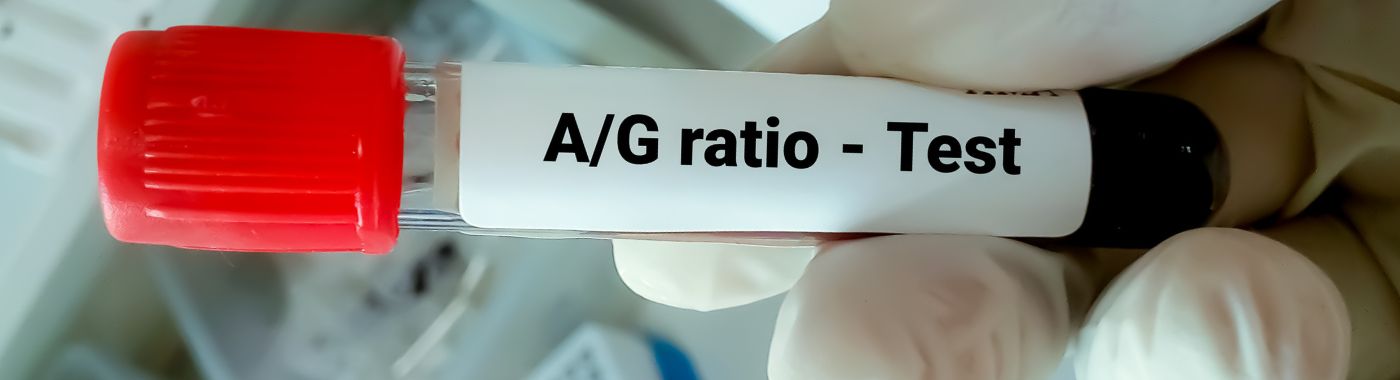
Resposta directa
The A/G ratio test compares albumin with globulin in blood, calculated from a serum total protein and albumin measurement. The A/G ratio is a screening clue, not a diagnosis. A low or high A/G ratio points your doctor towards liver disease, protein loss, chronic inflammation or a plasma-cell disorder, and usually prompts further testing.
Transport per emportar claus
- The A/G ratio is derived, not directly measured: globulin equals total protein minus albumin, and the ratio is albumin divided by globulin.
- The A/G ratio cannot name a disease, cannot identify which globulin is abnormal, and cannot exclude liver, kidney or bone-marrow disease.
- An abnormal ratio usually leads to targeted follow-up such as serum protein electrophoresis, liver function tests, urine protein testing or inflammatory markers.
- Reference intervals differ between laboratories and analysers, so read the range printed on your own report rather than one found online.
- Only the doctor who requested the test can interpret the A/G ratio alongside your symptoms, examination and other results.
A cop d'ull
| Article | detall |
|---|---|
| Què es mesura | Serum total protein and serum albumin; globulin and the A/G ratio are calculated |
| Mostra | Sang venosa, generalment del braç |
| Hora de l'extracció de sang | Typically about 5 to 10 minutes, including registration at the collection counter |
| Dejuni | Usually not required for total protein and albumin alone; fasting may be needed if bundled with lipid or glucose tests |
| Usually part of | Liver function test (LFT) panel or a comprehensive metabolic panel |
| Limitació principal | Non-specific; a normal ratio can hide significant disease and an abnormal ratio does not identify a cause |
| Common follow-up | Serum protein electrophoresis, immunoglobulin levels, urine protein/creatinine ratio, imaging |
També conegut com
- Relació albúmina-globulina
- A:G ratio, AG ratio
- Serum protein ratio (part of "total protein test")
- In Indian labs, often reported inside the LFT report alongside SGPT (ALT), SGOT (AST), bilirubin and alkaline phosphatase
- Commonly referred to by patients as "protein test" or "liver protein test"
What the A/G ratio test is
The A/G ratio test is a calculation performed on two laboratory values from the same blood sample. The laboratory measures serum total protein and serum albumin. Globulin is then obtained by subtraction, and the A/G ratio is albumin divided by globulin.
Albúmina is made by the liver. Albumin holds fluid inside blood vessels and carries hormones, calcium, bilirubin and many drugs.
Globulines are a mixed group: immunoglobulins (antibodies) made by plasma cells, plus transport and clotting proteins and acute-phase proteins made by the liver. Because globulin is a mixture, the calculated globulin value tells you the total but not which fraction has changed.
The A/G ratio therefore behaves like a signal that the balance between these two protein groups has shifted. The direction of the shift narrows the possibilities; it does not settle them.
Why the A/G ratio test is done
- As part of routine liver panels: a falling albumin with rising globulin can suggest chronic liver disease, though this is a late and insensitive change.
- To help evaluate unexplained protein abnormalities: when total protein is high or low and the reason is unclear.
- As a prompt for plasma-cell disorder workup: a persistently low A/G ratio with raised total protein may prompt serum protein electrophoresis to look for a monoclonal protein, as seen in multiple myeloma.
- In chronic inflammation or chronic infection: long-standing inflammation tends to lower albumin and raise globulins.
- In suspected protein loss: nephrotic syndrome, protein-losing enteropathy or extensive burns.
- For monitoring: tracking trends in known chronic liver disease or a known paraproteinaemia, alongside other tests.
Qui hauria de fer aquesta prova
- People with symptoms suggesting liver disease: persistent jaundice, abdominal swelling, ankle oedema, easy bruising.
- People with frothy urine, facial puffiness or leg swelling, where kidney protein loss is being considered.
- People with unexplained weight loss, bone pain, repeated infections or anaemia, where a plasma-cell disorder is in the differential.
- People with chronic diarrhoea or malabsorption.
- People on long-term treatment known to affect the liver, including anti-tubercular therapy, methotrexate or long-term herbal, AYUSH or gym supplement use, when a doctor has requested liver monitoring.
- People with known chronic liver disease, chronic kidney disease or autoimmune disease under periodic review.
The A/G ratio is not recommended as a standalone screening test in people without symptoms or risk factors. Results vary depending on individual clinical circumstances.
What the A/G ratio test cannot detect or exclude
- It cannot diagnose any single disease. No value is specific to cirrhosis, myeloma, lupus or nephrotic syndrome.
- It cannot identify which globulin fraction has changed. A raised globulin could be polyclonal (infection, inflammation, chronic liver disease) or monoclonal (a plasma-cell disorder). Only serum protein electrophoresis, with immunofixation where indicated, can distinguish these.
- A normal A/G ratio does not exclude liver disease. Albumin and globulin can remain normal in early or even moderately advanced liver disease, and in many cases of fibrosis. A normal ratio also does not exclude myeloma, some myelomas are non-secretory or light-chain only, with normal total protein.
- It does not measure liver inflammation or fibrosis. SGPT/SGOT reflect hepatocyte injury; fibrosis assessment needs elastography or other staging tools.
- It does not quantify urinary protein loss. That requires urine dipstick, urine protein/creatinine ratio or 24-hour urine protein.
- It does not assess nutrition reliably. Albumin falls in inflammation independently of diet, so albumin is a poor standalone nutritional marker.
- No és una prova de càncer. The A/G ratio does not screen for or exclude cancer.
A finding that is "not identified" on this test means it was not seen in these two measurements, not that it is absent. If symptoms continue despite a normal A/G ratio, return to your doctor.
Proves relacionades però diferents
| Test | Pregunta que respon | How it differs from the A/G ratio |
|---|---|---|
| Serum total protein | How much protein is circulating overall? | A single number; the A/G ratio breaks it into two components |
| Albúmina sèrica | How much albumin is present? | Directly measured; used for liver synthetic function and prognostic scores |
| Electroforesi de proteïnes sèriques (SPEP) | Which protein fraction is abnormal, and is there a monoclonal band? | Separates globulins into alpha-1, alpha-2, beta and gamma. Far more informative than a calculated ratio when a paraprotein is suspected |
| Immunofixation / serum free light chains | Is a monoclonal protein present and of which type? | Confirmatory tests after an abnormal SPEP; the A/G ratio cannot substitute |
| Liver function test (LFT) panel | Is there liver injury, cholestasis or impaired synthesis? | Includes SGPT/SGOT, bilirubin, ALP, GGT with albumin; the A/G ratio is only the protein element |
| Prothrombin time / INR | How well is the liver making clotting factors? | Responds far faster than albumin to acute liver failure |
| Urine protein/creatinine ratio | Is protein being lost in urine? | Measures the loss directly; the A/G ratio only shows the downstream effect |
| PCR / VSG | Is there active inflammation? | Explains why albumin may be low without liver disease |
Which test comes first depends on the clinical problem. For frothy urine and leg swelling, urine protein testing usually leads. For jaundice, an LFT panel leads. For bone pain with anaemia in an older adult, electrophoresis and light chains are more relevant than the A/G ratio.
Com preparar-se
Preparation is set by the laboratory performing the test, and your unit's written instructions take precedence over anything given here.
- Dejuni: total protein and albumin usually do not require fasting. Many Indian labs still ask for 8-12 hours fasting because the A/G ratio is ordered with lipid or glucose tests in a health package. Confirm with your collection centre.
- Medicaments: tell the laboratory and your doctor about all medicines and supplements, including corticosteroids, androgens, oestrogens and herbal or AYUSH preparations. Do not stop or change any prescribed medicine without speaking to the prescriber.
- Hidratació: normal fluid intake is preferable, since both dehydration and fluid overload shift the result.
- Posture and tourniquet: prolonged standing or a tight tourniquet held too long can raise measured protein slightly. The phlebotomist manages this.
Si esteu en dejuni i teniu diabetis amb tractament per reduir la glucosa
Prolonged fasting can cause hypoglycaemia, particularly with insulin or sulfonylureas. Ask your prescriber how to time the test and your medicines, and prefer an early-morning slot. Carry a sugar source.
Si teniu insuficiència cardíaca, malaltia renal crònica avançada o restricció de líquids
Do not increase fluid intake beyond your prescribed limit to "prepare" for a blood test. Follow the restriction your treating team has set.
Embaràs
Plasma volume expands in pregnancy, so albumin is physiologically lower and the A/G ratio is often lower than the non-pregnant range. This is expected and should not be read as disease.
nens
Paediatric protein values differ by age. Paediatric blood sampling uses smaller volumes and a smaller needle. Interpretation should be against age-appropriate ranges by a paediatrician.
Què passa durant la prova i quant de temps dura
A phlebotomist cleans a spot on the inner elbow, applies a tourniquet, inserts a needle into a vein and draws blood into a plain or gel tube. The tourniquet is released, the needle removed and pressure applied with cotton for a minute or two.
Temps triat: the draw itself typically takes under a minute, and the whole visit to a collection counter is usually around 5 to 10 minutes. Home collection appointments run to the visiting slot booked. Reporting time depends on the laboratory and whether the sample is processed in-house or transported to a central lab, ask your collection centre when you register.
Understanding your A/G ratio report
Your report will usually list total protein, albumin, globulin (calculated) and the A/G ratio, each with a reference interval printed beside it. Use the interval on your own report: reference intervals vary by analyser, method and laboratory, and also by age and pregnancy status.
Reading the pattern matters more than the number. The same ratio can arise from very different situations:
- Low ratio with low albumin and normal globulin: suggests reduced production (chronic liver disease), loss (kidney or gut) or inflammation.
- Low ratio with normal albumin and high globulin: raises the possibility of chronic infection, autoimmune disease, chronic liver disease or a monoclonal protein. Electrophoresis is the usual next step.
- Low ratio with high total protein: this combination is the one most likely to prompt testing for a plasma-cell disorder in an older adult.
- High ratio: may reflect low globulin, as in some immunoglobulin deficiencies, or occur with haemoconcentration. A high ratio is much less commonly clinically important than a low one, but should not be dismissed if there is a history of repeated infections.
A single borderline value in a person who feels well often means very little and may simply be repeated. Never diagnose yourself from this number. Interpretation belongs to the doctor who ordered the test, in the context of your history and examination.
When A/G ratio results can be misleading
Falsely raised albumin or A/G ratio
- Dehydration or haemoconcentration: concentrates all proteins, raising albumin and total protein.
- Prolonged tourniquet application or fist clenching: can spuriously raise protein and albumin.
- Standing upright for a long period before the draw: shifts fluid out of the vascular space and raises measured protein.
- Low globulin from immunoglobulin deficiency: raises the ratio without albumin being abnormal.
Falsely lowered albumin or A/G ratio
- Fluid overload or recent intravenous fluids: dilutes albumin.
- Lying flat for a prolonged period, including inpatients: lowers measured protein relative to ambulatory values.
- Acute inflammation or infection: albumin is a negative acute-phase reactant and falls within days, unrelated to diet or liver synthesis.
- Embaràs: physiological dilution.
- Haemolysed or lipaemic samples: can interfere with the dye-binding methods used for albumin, in either direction depending on method.
Method-related caveats
Albumin measured by bromocresol green versus bromocresol purple can differ, particularly at low albumin levels and in chronic kidney disease. Because globulin is calculated by subtraction, any error in albumin or total protein is carried directly into the globulin value and the ratio. This is one reason small differences between labs should not be over-interpreted.
Riscos i seguretat
Extracció de sang venosa rutinària
Complications are uncommon. Possible effects include brief pain, bruising, a small haematoma, light-headedness or fainting, and rarely local infection. Tell the phlebotomist beforehand if you have fainted during blood tests previously, so you can be drawn lying down.
If you take blood thinners or have a bleeding disorder
Bruising is more likely and pressure may need to be held for longer. Tell the staff before the draw. Do not stop anticoagulants for a blood test unless your prescriber has instructed it.
If you have had lymph node surgery or a dialysis fistula
Tell the phlebotomist so the affected arm can be avoided.
Banderes vermelles
Busca atenció d'emergència ara
- Vòmits de sang o femtes negres i enganxoses.
- New confusion, drowsiness or disorientation in someone with known liver disease.
- Severe breathlessness or breathlessness at rest.
- Rapidly worsening abdominal swelling with fever and abdominal pain.
- Collapse, or bleeding from the puncture site that does not stop with 10 minutes of firm pressure.
Arrange a same-day review
- New jaundice (yellow eyes or skin), or dark urine with pale stools.
- New facial puffiness with frothy urine and rapidly increasing leg swelling.
- Fever with bone pain and marked fatigue in an older adult.
- Spreading redness, warmth or increasing pain at the blood draw site.
Reserva una cita rutinària
- A mildly abnormal A/G ratio in someone who feels well.
- Gradual fatigue, mild ankle swelling or unexplained weight change.
- A persistent abnormal result on repeat testing, for planned further evaluation.
Situacions especials
Embaràs
Lower albumin and a lower A/G ratio are expected. Interpretation must use pregnancy-aware judgement, and abnormal results should be assessed alongside blood pressure and urine protein where pre-eclampsia is a consideration.
nens
Reference values shift with age, and neonatal values differ substantially. Paediatric results should not be compared with adult ranges.
Adults majors
Albumin tends to be slightly lower with age and with frailty or chronic illness. A low A/G ratio with raised total protein in someone over 60 carries more weight and commonly leads to electrophoresis.
Malaltia renal crònica i diàlisi
Albumin is influenced by protein loss, inflammation and fluid status, and by dialysis timing. Trends matter more than single values.
Atac de cor
Fluid overload dilutes albumin, and congestive hepatopathy can also affect liver proteins. Interpret alongside fluid status.
Diabetis amb medicaments per reduir la glucosa
The test itself is unaffected, but fasting instructions from a bundled package need to be coordinated with the prescriber.
The A/G ratio test in the Indian context
- Bundled into LFT reports: most Indian laboratories report the A/G ratio automatically within the liver function test, alongside SGPT and SGOT. Many people first encounter the number without having specifically asked for it.
- Chronic infection is a common cause of raised globulin: tuberculosis, chronic hepatitis B and C, and other long-standing infections can raise globulins and lower the ratio without any plasma-cell disorder.
- Hepatitis A i hepatitis E remain important causes of acute hepatitis in India. In acute illness, bilirubin, SGPT/SGOT and INR are far more informative than the A/G ratio, which changes slowly.
- Lesió hepàtica induïda per fàrmacs from anti-tubercular therapy, some AYUSH and herbal preparations, and unregulated gym supplements is a recognised problem. Tell your doctor everything you are taking, including products bought without a prescription.
- Malaltia hepàtica metabòlica amb un IMC més baix: South Asians develop metabolic dysfunction-associated steatotic liver disease (MASLD, the term that replaced NAFLD; MASH replaced NASH) at lower body weight than many other populations. The A/G ratio is not a screening test for MASLD.
- Nutritional and inflammatory overlap: iron-deficiency anaemia and undernutrition are common and often coexist with chronic inflammation, so a low albumin should not automatically be labelled "poor diet".
- Protecció de dades: laboratory reports and any online booking forms involve personal health data handled under the Digital Personal Data Protection Act, 2023.
Cost i assegurança a l'Índia
The A/G ratio is not usually priced as a standalone test, because it is derived from total protein and albumin. In practice you pay for either a serum total protein with albumin, or a full LFT panel that includes it. Costs differ widely between a standalone government facility, a small local laboratory, a chain diagnostic brand and a corporate hospital lab.
Factors que afecten el que pagues:
- Whether the test is standalone, inside an LFT panel, or inside a larger health check-up package.
- City and locality, and whether the sample is processed in-house or transported.
- Home collection charges and urgent or after-hours processing.
- NABL accreditation status and the analyser platform used.
- Whether follow-up tests such as serum protein electrophoresis are added, these cost considerably more than the base panel.
Assegurança: outpatient diagnostic tests are often not covered by standard indemnity health insurance unless an OPD rider applies. When the test is done during an admissible hospital admission, it is generally covered as part of investigation charges. Check your policy wording and pre-authorisation requirements before assuming coverage.
Mites i fets
| Mite | Fet |
|---|---|
| A low A/G ratio means liver disease. | A low ratio has many causes, including infection, inflammation, kidney protein loss and plasma-cell disorders. It does not identify the cause. |
| A normal A/G ratio means the liver is healthy. | Albumin and globulin can stay normal in early and even significant liver disease. A normal ratio does not exclude liver disease. |
| The A/G ratio can detect cancer. | The A/G ratio is not a cancer test. An abnormal pattern may prompt electrophoresis for a paraprotein, which is a different investigation. |
| Low albumin means you are not eating enough protein. | Albumin falls during inflammation regardless of diet. Albumin is an unreliable standalone marker of nutrition. |
| Eating more protein or drinking protein shakes will correct the ratio. | Correcting the ratio depends on treating the underlying cause. Some supplements can themselves harm the liver or kidneys. |
| You must fast 12 hours for an A/G ratio. | Total protein and albumin generally do not require fasting. Fasting instructions usually come from other tests in the same package. |
Preguntes freqüents
Is the A/G ratio measured directly in the laboratory?
No. The laboratory measures serum total protein and serum albumin. Globulin is calculated by subtracting albumin from total protein, and the A/G ratio is albumin divided by globulin. Because two measurements feed one calculation, small analytical differences can shift the ratio, which is why trends matter more than one value.
What happens after an abnormal A/G ratio?
Your doctor interprets the pattern rather than the number alone. Depending on your symptoms, next steps may include repeating the test, serum protein electrophoresis, immunoglobulin levels, urine protein/creatinine ratio, inflammatory markers, viral hepatitis testing or abdominal imaging. The follow-up is chosen by clinical suspicion, not by the ratio value on its own.
Can dehydration change my A/G ratio?
Yes. Dehydration concentrates blood proteins and can raise both albumin and total protein, shifting the ratio. Conversely, intravenous fluids or fluid overload dilute albumin and lower the ratio. Normal fluid intake before the test is sensible, but do not exceed a prescribed fluid restriction to prepare for a blood test.
Does a normal A/G ratio rule out multiple myeloma?
No. Some myelomas produce only light chains or no measurable paraprotein, and total protein can be normal. If bone pain, unexplained anaemia, high calcium or kidney impairment is present, your doctor will order serum protein electrophoresis with immunofixation and serum free light chains regardless of the A/G ratio.
How is the A/G ratio different from a liver function test?
The LFT panel is broader. SGPT and SGOT reflect liver cell injury, bilirubin and alkaline phosphatase reflect bile flow, and albumin reflects synthetic capacity. The A/G ratio is only the protein component of that panel and cannot show liver injury or bile obstruction on its own.
Is the blood draw painful, and how long does it take?
Most people feel a brief sting. The draw itself lasts well under a minute, and a typical visit to a collection counter takes about 5 to 10 minutes including registration. Tell staff if you have fainted during blood tests before, so the sample can be taken with you lying down.
Why is my A/G ratio low during pregnancy?
Plasma volume rises substantially in pregnancy, diluting albumin. A lower albumin and therefore a lower A/G ratio is a normal physiological change, not a sign of liver or kidney disease. Your obstetrician interprets it alongside blood pressure, urine protein and other pregnancy-specific tests.
Should healthy people get an A/G ratio test as a screening check?
There is no good reason to order it alone in someone without symptoms or risk factors. It appears in health packages because it is bundled with liver panels. Isolated mildly abnormal results in well people often lead to anxiety and repeat testing rather than useful findings.
Fonts
- National Library of Medicine, MedlinePlus Medical Encyclopedia, Total protein and albumin/globulin (A/G) ratio.
- Rinella ME et al. A multi-society Delphi consensus statement on new fatty liver disease nomenclature. Hepatology / Journal of Hepatology, 2023 (MASLD, MASH, MetALD terminology).
- International Myeloma Working Group criteria for the diagnosis of multiple myeloma (Rajkumar SV et al., Oncologia Lancet, 2014), role of serum protein electrophoresis and free light chains.
- Kidney Disease: Improving Global Outcomes (KDIGO) guidance on the evaluation of proteinuria and chronic kidney disease.
- Clinical and Laboratory Standards Institute guidance on venous blood collection and pre-analytical variables, including posture and tourniquet effects.
- Llei de protecció de dades personals digitals de 2023, Govern de l'Índia.













 Millor hospital a prop meu Chennai


