


NEWS
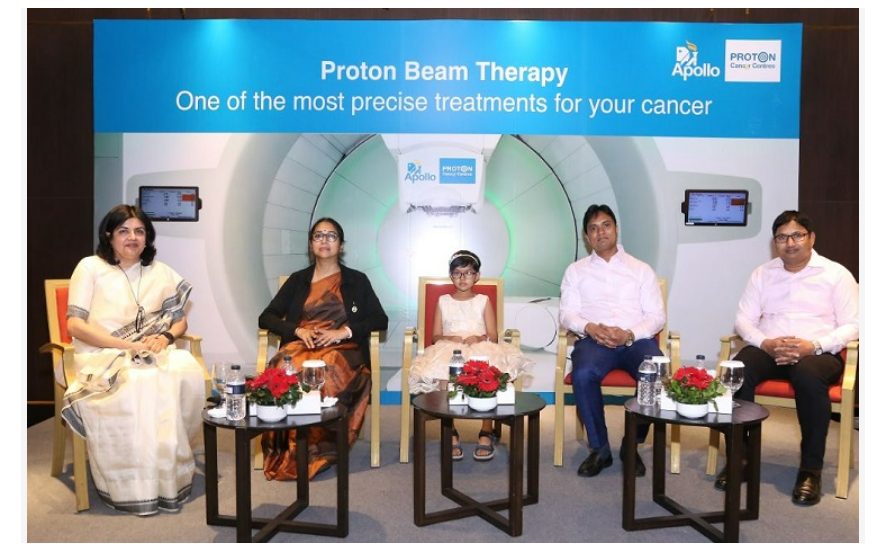
A 6-yr-old girl from Bangladesh was successfully treated with proton beam therapy at Apollo Proton Cancer Centre
Mar 4, 2023A 6-yr-old girl from Bangladesh was successfully treated with proton beam therapy at
Apollo Proton Cancer Centre
04 March, 2023
Dhaka : The Apollo Proton Cancer Centre (APCC), the first and only proton
therapy centre in South Asia and the Middle East, successfully treated a 6-year-old girl from
Bangladesh with diffuse midline glioma, a primary central nervous system (CNS)
tumour, with definitive radiotherapy and proton beam therapy. The advanced
technology at APCC and the timely medical intervention by the experts helped the child to
recover quickly.
Miss Debosmita Sarkar from Dhaka, came to India with complaints of double vision and
restricted movement in the left eye. She also had difficulty using her right upper and lower
limbs. After further evaluation, she was diagnosed with diffuse midline glioma, CNS WHO Grade 4.
Her case was discussed in the APCC Neuro-Oncology CMT MDT, and the guarded prognosis was
explained to her parents for definitive radiotherapy with proton beam therapy, which she
completed in September 2022. Later, her MRI reports showed a reduction in the size of the
tumour. The extensive and well-planned treatment yielded the much-needed results for the child
to showcase her winning over cancer. Her case highlights the importance of early detection and
prompt medical intervention in the management of brain tumours in children.
Dr Sapna Nangia, Senior Consultant, Radiation Oncology, Apollo Proton Cancer Centre, Chennai,
India, said, “I’ve seen significant advantages of proton beam therapy over traditional
radiation treatments at Apollo Proton Cancer Center. By precisely targeting tumours with a
focused beam of high-energy protons, we can spare healthy surrounding tissues and minimize the
risk of collateral damage, particularly in vital organs and sensitive areas. This approach can
translate to improved outcomes for patients, including better cancer control rates, reduced risk
of side effects, and overall enhanced quality of life.”
Sharing his daughter’s treatment at APCC, Dr Debashish Sarkar, said, “Being at APCC for my
daughter’s treatment was the silver lining among the darkest of clouds in my life. I am grateful
to the doctors and staff for being supportive and understanding of my daughter’s needs. I would
strongly advise the best treatment to any friend who is fighting cancer.”
The major advantage of proton therapy treatment is that protons slowly deposit their energy as
they travel towards the cancerous tumour and deposit most of the radiation dose directly into
the tumour without damaging the body further thus maintaining healthy tissues and organs without
any complications. Proton therapy has been shown to have excellent local control of various
cancers located in some of the most difficult areas such as skull-base regions of the body which
are otherwise difficult to treat. The latest breakthroughs in this technology including pencil
beam scanning, highly precise image guidance and tremendous refinements in the machine set-up,
have led to the adoption of this technology throughout the world in hospital settings.
Proton therapy is being encouragingly adopted for the treatment of various cancers such as brain
and spine tumours, skull base tumours, oral cancers, gastro-intestinal cancers, bone and soft
tissue tumours, breast cancers, thoracic cancers (lung cancer), genitourinary cancers (prostate
cancer) and predominantly in paediatric cancers except for leukaemia.