






Small Incisions, Big Impact: Advanced Varicocelectomy Procedures

Book Appointment

Explore the pinnacle of advanced varicocelectomy excellence at Apollo Hospitals Hyderabad. Our expert team of doctors delivers unparalleled safety and success rates, positioning us among the top hospitals for varicocelectomy. Through our comprehensive care and steadfast commitment, we accompany you on a journey towards improved health, longevity, and parenthood.

Why Choose Us ?

Descriptive Alt Text 1
Unmatched Expertise

Our doctors, educated at renowned global institutions, have extensive experience. They stay updated with the latest treatment methods and offer precise, compassionate care to all our patients.

Descriptive Alt Text 2
Advanced amenities

Our latest high-end technology and top-notch infrastructure will help the patient with a quick diagnosis and recovery. We utilise the advanced, high-end TIVATO 700 Zeiss surgical microscope for varicocelectomy.

Descriptive Alt Text 3
Dedication to innovation

We offer unmatched patient care and all-inclusive, multidisciplinary treatment. In order to provide patients with high-quality care, we house renowned and experienced medical specialists for microscopic subinguinal varicocelectomy.

Microsurgical Subinguinal Varicocelectomy

During this procedure, a high-powered operating microscope is used for a microsurgical varicocelectomy, which can be done under general or spinal anaesthesia. The aim is to seal off the affected vein and redirect blood flow to healthy veins. There are two surgical approaches in microscopic surgery: inguinal and subinguinal.

Both approaches involve small incisions, typically less than an inch long. The spermatic cord is dissected to access the abnormal veins, which are then sealed or tied. Blood flow is redirected away from the affected area.

Benefits of Microsurgical Varicocelectomy

  • Reduces the likelihood of postoperative complications such as hydrocele or recurrence compared to laparoscopic varicocelectomy.
  • It is an effective surgical method for addressing varicoceles, whether related to infertility or chronic pain.
  • It offers a pain-free recovery.
  • It is a daycare surgery.
  • You can resume your daily routine in 2 to 3 days.
  • This surgery also promotes the production of the male hormone testosterone, contributing to its excellent success rates.
Descriptive Alt Text 1

Pre-Operative Instructions

Once you decide to proceed with varicocele surgery, follow these steps:

  • Get a minor or major surgical profile as advised by your doctor, considering your age and any comorbidities.
  • Complete a pre-anaesthesia check-up and obtain fitness for surgery from the anaesthesia team. Further evaluation by other specialists may be required based on the physical examination and lab reports.
  • Provide your full medical history, previous surgeries, current medications, and any drug or anaesthesia complications.
  • Stop blood thinners like Aspirin, Warfarin, or Clopidogrel 3 to 5 days before surgery and inform your doctor about any allergies.
  • Shower on the day of surgery to prevent infections.
  • Eat a normal dinner the night before. No food or drink 6 hours before surgery; only sips of water up to 4 hours prior. Breaking these rules may delay or postpone your surgery.
  • Take regular medications with sips of water as per the anaesthetist's instructions.

On the day of surgery:

  • Arrive 1 to 2 hours early. Be prepared for possible delays.
  • The doctor will explain the procedure and its complications. Sign the informed consent form.
  • Shaving of the operation site may be required.
  • Change into a surgical gown, removing all clothing, undergarments, dentures, jewellery, and contact lenses.
  • Empty your bladder before the operation.
  • You will be transferred to the operation theatre on a wheelchair or stretcher.

Post-Operative Care After Discharge

The patient is usually discharged within a day after surgery. Mild to moderate scrotal discomfort may last for days or weeks. You can resume working within three days post-surgery.

  • Pain relief medication will be administered for your comfort.
  • After surgery, you might experience difficulty urinating. In some cases, a urinary catheter may be inserted into your bladder to help empty it. The catheter is typically removed within 1-2 days.
  • It is advised to avoid physically demanding activities (sexual abstinence or masturbation) for at least 3 weeks following the procedure.
  • Scrotal support is recommended for 3 weeks.
  • Post-op follow-up after 2 to 3 days for dressing removal and wound inspection.
  • A normal diet can usually be resumed about 6 hours after recovering from anaesthesia. Start with fluids and gradually transition to solid foods by the day after surgery.
Descriptive Alt Text 1

Conditions That May Require Treatment for Varicocele

...

Adolescents aged 12 to 18 presenting with a significant varicocele and noticeable reduction in testicular size require proper treatment. Even in the absence of pain or other symptoms, varicocele treatment is advised to enhance the function of the affected testicle.

...

Anyone experiencing testicular pain caused by a varicocele typically describes it as a 'dragging' sensation that worsens with prolonged exercise or standing.

...

In men who are sub-fertile or infertile due to a varicocele, correcting the varicocele can lead to a 50%-70% improvement in those with a low or poor sperm count.

Treatments for Varicocele

Depending on your condition, your doctor may recommend one of the following treatments for varicocele:

...
Microsurgical Subinguinal Varicocelectomy

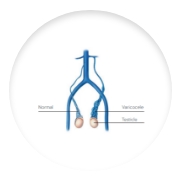
In this procedure, a high-powered operating microscope is used to perform the varicocelectomy. The physician makes an incision in the groin and examines the veins with the microscope, then ligates and cuts all the problematic veins. It is the only method to ligate external and all internal spermatic veins, which is not possible by embolisation or laparoscopy

...
Varicocele Embolisation

During this varicocele treatment, a tiny catheter is inserted into a vein in the groin. A coil is then inserted through the catheter and advanced into the varicocele.

...
Laparoscopic Surgery

During this procedure, the surgeon inserts a tiny device and a special camera into the abdomen to view and treat the varicocele. However, this is not the latest standard for varicocelectomy treatment.

FAQs

Your doctor may not recommend the procedure if you have a small varicocele that doesn't cause discomfort or fertility issues. However, if you have a higher-grade varicocele and it is left untreated, it can cause permanent damage to your testicles.

Varicocele can significantly impact male fertility by reducing sperm count, motility, and altering sperm structure. It often leads to abnormalities in semen parameters. Varicocele can also increase oxidative stress and result in high levels of DNA fragmentation in sperm.

Microsurgical varicocele repair boosts testosterone levels and improves patient-reported erectile and ejaculatory functions. Patients can be assured that varicocelectomy has the potential to enhance sexual function in addition to increasing serum testosterone.

Most men can return home on the same day as the procedure. You will have stitches and skin glue on your incisions, with the stitches dissolving on their own. It is normal to experience some discomfort and swelling around the incision, which should decrease within one to two weeks.

For infertile men who have varicoceles that are palpable or visible during a scrotal examination, microsurgical varicocelectomy is the best option. If the female partner is fertile or has an infertility condition that can be treated, then the procedure can be a feasible alternative for infertile couples. Men who have pain, aberrant semen profiles, or testicular atrophy can also be considered for the surgery.

After microsurgery, immediate results are not expected because sperm formation in the human body takes 70 to 90 days. This means one spermatogenic cycle takes about 2.5 to 3 months. Therefore, it is necessary to allow time for two spermatogenic cycles, or approximately 3 to 6 months, for noticeable changes. Doctors will check semen parameters at 3 and 6 months post-surgery. Most patients will see an improvement in sperm count by the 6-month mark.

A microsurgical varicocelectomy involves using a microscope to locate the affected blood vessels through a groin incision. Although this approach has the lowest complication rate, it takes longer to perform than other surgical methods. The risk of recurrence is 1%, and the risk of developing a hydrocele is 0.44%.

Book Appointment

© Copyright 2024. Apollo Hospitals Group. All Rights Reserved.
Book an Appointment